AHMEDABAD: Ahmedabad district collector invoked the Criminal Procedure Code's Section 144 here on Tuesday, prohibiting mass gatherings without prior permission in order to prevent swine flu, an official statement stated.
"It has come to our notice that swine flu cases have been on the rise in Gujarat including Ahmedabad. The virus, which causes swine flu, is contagious and generally infects people by entering through nostrils and mouth mostly at crowded places," the Ahmedabad district collectorate statement said.
The move has come after Gujarat registered more than 230 swine flu deaths, which include more than 50 fatalities in Ahmedabad, since January this year. The number of positive cases swine flu recorded in Gujarat is 3,527 and the disease has caused the highest number of deaths in Gujarat compared to other states in the country.
However, the Collector has exempted people gathering at marriages and death processions from Section 144.
If public events cannot be called off or postponed, organisers would have to take prior permission also have to ensure that proper care is being taken to stop the spread of swine flu, like providing masks to all people as well as dispose off these masks after their use, the statement said.
It added that organizers of such events should display big billboards with swine flu prevention measures like washing of hands with soap at regular intervals.
Meanwhile, swine flu on Tuesday claimed 12 more lives in Gujarat, taking the total number of deaths due to the H1N1 virus to 231 so far even as 190 new positive cases were detected in a day.
"Gujarat has recorded 12 swine flu deaths and 231 new cases today. While the total number of deaths has climbed to 231, and that of positive cases to 3,527 since January this year," according to an official statement issued by Gujarat government.
Me, myself and I. When you have these three in your life, who else do you need? Spending time alone is such a liberating feeling. When you are with your favorite person, you can do your favorite thing without being judged. So if you love spending time by yourself, then here are 10 reasons, why spending time alone is the best thing ever!
1. Thinking clearly becomes easier.
You can think clearly without any pressure from the outside world.
Being by yourself is a great feeling, so why not give yourself a great gift this valentines day, for just being you. Experience#UnconditionalLove with the Zenfone. It's time to pamper yourself!
રાયપુરના જયસ્તંભ ચોકમાં સાહૂજી રોજ સવારે 6થી 10 વાગ્યે લારી લગાડે છે. તેમની લારી પર ન તો કોઈ નામ છે કે નથી કોઈ વિજ્ઞાપન. નવા લોકો આ લારી પર લોકોની ભીડ જોઈને અંદાજ લગાવે છે કે આ તેમની જ હશે. તેમની પાસે પૌંઆ ખાવા આવતા ગ્રાહકો તેમની સાથે સેલ્ફી પડાવી સોશ્યલ નેટવર્કિંગ સાઈટ પર મૂકે છે.
જોરાપારાના નિવાસી સાહૂ અહિં વર્ષોથી પૌંઆની વેચે છે. તેમને પૂછતા સાહૂ કહે છે કે સવારે 6થી 10 અહિં પૌઆ વેચું છું અને ઘર ખર્ચ નીકળી જાય છે. તેમના ઘણા સંબંધીઓ શહેરમાં અલગ અલગ જગ્યાએ નોકરી કરે છે.
તેમનો દિવસ સવારે 4 વાગ્યે શરૂ થાય છે. ઘરે પૌંઆ બનાવીને લગભગ સાડા છ વાગ્યે ચોકમાં લાગી લગાવે છે. તે રોજ લગભગ 20 કિલો પૌંઆ બનાવે છે. તે લોકોને દિવસના લગભગ 400 ડીશ પૌઆ ખવડાવે છે. વર્ષોથી 20 રૂપિયા ડીશના હિસાબે દિવસના 8000 રૂપિયા કમાઈ લે છે. અને મહિને લગભગ 2 લાખ રૂપિયા પાડે છે.
Mahashivratri falls on Magh Krishna Chaturdashi. On this day, the Shiva principle descends to Earth a thousand times more than usual. On this day, to obtain the full benefit of Lord Shiva’s principle, one should chant ‘Om Namah Shivaya’ as much as possible.
Shivratri is the time when Shiva takes a rest. Shiva rests for one ‘prahar’ (three hours) of the night. This ‘prahar’ is referred to as the Shivratri. When Lord Shiva takes rest, the function of ‘Shivtatva’ (Shiva Principle) ceases, i.e. Lord Shiva goes into a meditative state. Shiva’s meditative state is the time when He is engrossed in His own spiritual practice. During that time, the ‘Shivtatva’ does not accept any tamogun (most base of the 3 elements in us – sattva, raja & tama) or any halahal (venom churned from the ocean) coming from the Universe. As a result, the ratio of halahal or the pressure of the negative energies increases. For protection from this pressure, things like ‘bilva patra’, white flowers, ‘rudraksha’ beads etc are offered to Lord Shiva. These things attract the ‘Shivtatva’ from the atmosphere, thus providing protection from the increasing effect of the negative energies. The Earth is a gross object. Gross objects have very low velocities i.e. they require more time to cover a specific distance in space. Gods on the other hand, are subtle hence they are capable of traversing space within a few seconds. That is why one year on the earth is equivalent to just one day of heaven. - Brahma-tatva (18.02.2004, 3.05 p.m.)
Science in the worship of Lord Shiva on Mahashivratri
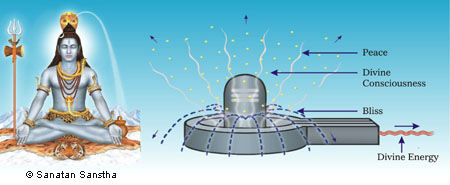
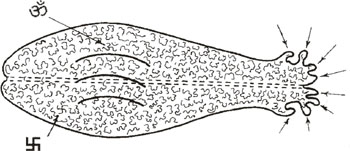
The function of the ‘Shivpindi’
1. Emitting waves of Knowledge, Devotion and renunciation
Predominantly ‘sattva’ waves of knowledge, ‘raja’ waves of devotion and ‘tama’ waves of Renunciation (Vairagya) are emitted by the ‘Shivpindi’. During Mahashivratri, the emission increases by 30 percent.
2. Emission of subtle vibrations of chaitanya, bliss and peace
The ‘Shivpindi’ emits subtle vibrations of chaitanya, bliss and peace. During the Mahashivratri, the emission increases by 25 percent. This helps purify the subtle-body of one who worships the Shivpindi on this day. The ‘sun’ or the ‘moon’ channels in the body get activated as per necessity. The capacity to absorb the sattvaguna and chaitanya also increases. Due to the presence of the unmanifest Shiva principle in the Shivpindi and the vibrations of peace emitted, the Shivpindi remains cool and the mind too experiences peace. Worship of Shivpindi with devotion, activates the dormant Shiva principle. An offering of puffed rice and milk reaches Lord Shiva in the subtle form.
3. Receiving the ‘tarak or marak tatva (element)’ as required
There is a confluence of the manifest and the unmanifest elements along with the ‘tarak and marak tatva’ in the Shivpindi. (Tarak = Saviour; Marak = Destroyer). That is how worshipers receive the required element. The temperature of the Shivpindi increases due to the emission of the marak tatva and there one experiences bliss. Similarly, when the tarak tatva is emitted, the temperature drops and one experiences peace and bliss.
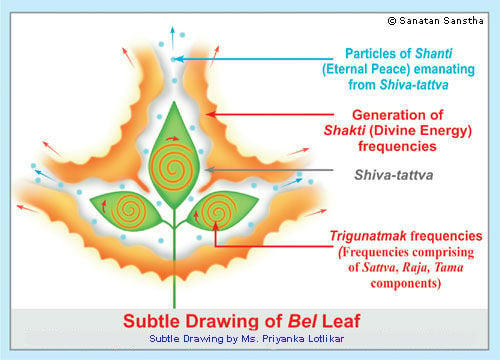
Bilvapatra contains 2% Shiva tatva. By offering bilvapatra to the Shivpindi on Mahashivratri, the manifest Shiva tatva near the stalk of the bilvapatra gets activated. Due to this, waves of chaitanya as well as Shiva tatva are emitted by the bilvapatra. The bilvapatra attracts 20% of the Shiva tatva present in the Shivpindi towards itself. By immersing this bilvapatra in water or by placing it in grains, the Shiva tatva present in the bilvapatra is transmitted to them. The Shiva tatva in the bilvapatra is activated to a larger extent on Mondays when it transmits 10% of the Shiva tatva and sattvikta. On other days only 1% of the Shiva tatva is activated in the bilvapatra.
Bilvarchan
Offering bilvapatra to the Shivpindi and chanting the mantra ‘Om Namah Shivaya’ with each offering is known as bilvarchan. Continue offering the bilvapatra until the pindi is completely covered. Offer the bilvapatra from the lower part of the pindi. By starting from the feet of the idol, more benefit is derived and the idol can be covered completely. - Brahma-tatva (22.02.2004, 9.30 p.m.)
Chanting on Mahashivratri ‘Om Namah Shivaya’
Om represents an unmanifest state beyond the 3 gunas (elements of sattva, raja & tama). We bow to Lord Shiva, from whom Om was created.
Naampatti made by Sanatan Sanstha Seekers to remind Naamjap
What does the word ‘Shiva’ mean?
a. The word Shiva has been derived by reversing the letters of the word vash. Vash means to enlighten; thus the one who enlightens is Shiva. He remains radiant and also illuminates the universe.
b. He is the auspicious and prosperity-bestowing principle.
Some unique attributes
1. Physical attributes
a. Ganga : Just as the sun is the focal point of the solar system and the soul that of the body, the focal point of divine consciousness (chaitanya) in every object and pure particles (pavitrakas) is ga-aum. The flow from which ga-aum originates is gan gaha = Ganga. Ga-aum flows from Shiva’s head. This is called the descent of the Ganga from Shiva’s head. Since the river Ganga has a fraction of the principle of the spiritual Ganga, no matter how polluted it becomes, its purity is perpetually retained. Hence, when compared to any other water in the world, the water from the Ganga is the purest. This is realised not only by those who can perceive the subtle dimension but also by scientific researchers.
b. Moon : Shiva adorns the chandra (moon) on His forehead. The point where the three frequencies – affection (mamata), mercifulness (kshamashilata) and motherly love (vatsalya) originate is referred to as the chandra (moon). Thus, one can conclude that chandrama (the moon principle) is the state in which the three attributes of affection, mercifulness and motherly love are present.
c. Third eye : Shankar is three-eyed, i.e. He can perceive events of the past, present and future.According to the science of Yoga the third eye means the Sushumna nadi (channel).
d. Serpent : One of the Names of Lord Shankar is Bhujanga-patihari. Bhujang means a serpent or pure particles (pavitrakas), pati means the nurturer and hari means one with a garland around His neck. Bhujangapatihari thus means the One who nurtures pure particles and wears them like a garland. Various serpents represent groups of pure particles. Though externally they appear like serpents, internally they are a kind of ladder. To make spiritual progress one has to climb up holding onto the tail of the serpent. Lord Shankar adorns serpents at nine points on His body – one on the head, one around the neck, one on each arm, one on each wrist, one around the waist and one on each thigh. This implies that His body is comprised of pure particles or that serpents of pure particles play all over the body of Lord Shankar who has the universe as His form.
2. Spiritual attributes
a. One performing severe austerities and the great yogi
Shiva is always seated in a bandha or a mudra. His temperature rises due to heat generated by performing severe austerities; Hence, He uses the Ganga, the moon and serpents which endow a cooling effect and lives on the snow-clad Kailas mountain.
b. Short tempered
If someone disturbs His meditation the radiance generated by spiritual practice will be suddenly expelled and whoever is in front of Him will not be able to tolerate it, and gets destroyed. This is referred to as being ‘reduced to ashes by Shankar’s opening of the third eye’.
c. One who is willing to undergo any distress for the sake of imparting happiness to others
The poison generated during the churning of the celestial ocean (samudramanthan) was burning the entire Universe but no deity came forward to accept it. At that time Shiva drank that poison and saved the world from destruction.
d. One who has both, deities and demons, as His worshippers
Neither did demons like Banasur, Ravan, etc. worship Lord Vishnu nor did Lord Vishnu bestow any boon upon any demon. However, they worshipped Lord Shiva who blessed them.
e. Master of the spirits
Since Lord Shiva is the master of spirits, His worshippers are generally not possessed by them.
Lord Shiva’s mission
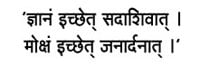
1. Jagadguru (Master of the Universe)
Meaning : One should worship Shiva for spiritual knowledge and Janardan (Vishnu) for the Final Liberation (Moksha).
2. One leading to a state beyond the three components
Shankar destroys all the three components of Prakruti – sattva, raja and tama, in a Jiva (Embodied soul) simultaneously.
Science in the idol – in the Human form
In the human form, Lord Shiva possesses the following four symbolic instruments in his hands.
1. Damaru
This represents the Brahman in the form of the word (shabda Brahman). Alphabets consisting of the sounds of fifty-two basic letters and the forms of fourteen Maheshvar verses (sutras) have generated from it. Later the universe was created from these.
2. Trident : represents the following -
The three components – sattva, raja and tama
The root of creation, sustenance and dissolution
Volition, knowledge and action
3. Noose (pash) : The noose represents the noose of time (kalpash) (The rope in Lord Ganapati’s hand too is the same).
Worship
a. Application of holy ash (Bhasma)
Tripundra refers to the three horizontal stripes of holy ash applied to the forehead. These stripes symbolise spiritual knowledge, purity and penance (spiritual practice of Yoga), so also they represent the three eyes of Lord Shiva.
b. Wearing a rudraksha
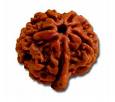
Wearing a rudraksha when worshipping Lord Shiva is ideal. A rudraksha is reddish in colour with yellow stripes and is flat like a fish. On one side it has a slight opening which appears like an open mouth. The rudraksha converts light frequencies of deities from the universe into sound frequencies in the body of humans and vice versa. As a result, humans can absorb frequencies of deities and thoughts can get converted into the language of deities.
A Genuine Rudraksha
The rudraksha absorbs sama (sattva) frequencies. Similarly sama frequencies are emitted by its crests. A real rudraksha can be recognised by the vibrations felt by holding it in the hand. At that time the body absorbs the sama frequencies emitted by the rudraksha. (For more information on this, refer to the Publcation, named at the end of the article.) Nowadays, mostly Vikrutaksha is sold as a rudraksha. This is the seed of a type of wild berry. Vikrutaksha is used for sacrificial fires of tantriks, black magic etc. by sorcerers.
c. Ritualistic worship of the pindi
Only cold water and bel is offered to Lord Shankar’s pindi. Neither is it bathed with milk and panchamrut (a mixture of milk, curds, ghee, sugar and honey) nor offered turmeric, vermilion (kumkum) or white consecrated rice (akshata). Milk and clarified butter (ghee) symbolise sustenance while turmeric is an underground stem and represents fertility of the soil, that is creation. Vermilion is prepared from turmeric. Since Lord Shiva is the deity of dissolution, substances such as milk, vermilion and turmeric are not used in His worship.
d. Circumambulation (pradakshina)
When circum-ambulating one should begin from the left side and continue till the channel of the shalunka from where the water offered during the ritualistic bathing (abhishek) flows. Without crossing it one should complete a circum-ambulation by moving in the reverse direction up to the other side of the channel. The flow of a shalunka is not crossed as it is the flow of energy which adversely affects the formation of semen and the five internal vital energies (pran vayu).
e. Chanting the Name of Lord Shiva
‘Namaha Shivaya is Shiva’s five-syllabled mantra. The spiritual meaning of each of the five syllables is: na = Foremost deity of all the regions (lokas) ma = Bestower of supreme spiritual knowledge (gyan) and redeemer of the greatest of sins shi = Benevolent, serene and responsible for initiation by Lord Shiva va = Symbolic of a bull as the vehicle and Vasuki and Vamangi energy (shakti) ya = Auspicious abode of Supreme Bliss and Lord Shiva. Hence, obeisance (namaskar) to these five syllables.
(Ref. : Sanatan’s Publication : Science of Spirituality : Shiva Compilers : HH Dr Jayant Athavale and Dr (Mrs) Kunda Jayant Athavale)
Courtesy: Monthly Sanatan Prabhat
Videos
Videos included in the above playlist:
1. Significance of Lord Shiva’s Form
2. Subtle Picture of Lord Shiva
3. Subtle Picture of Lord Shiva – 2
4. Subtle Picture of namestrip “Om Namah Shivay”
5. Information and significance of Lord Shiva’s Trishul
6. Information and significance of Rudraksha
7. Significance of the status of Nandi
8. Methods of Shrungdarshan
9. Benefits of Shrungdarshan
10. Taking darshan of Shiv Pindi
11. Significance of Shiv Pindi
12. Sutble effect of Shiv Pindi
13. Role of Shiv Pindi
14. Method of applying Bhasma (Holy Ash)
15. Subtle effect of applying Bhasma (Holy Ash)
16. Where to sit to perform puja in Shivalay
17. Why to apply Bhasma (Holy Ash) to Shiv Pindi
18. Method to offer Bel leaf (Bel Patra leaf) to Shiv Pindi
Your commentI clearly enjoyed the show but guys this is not the kind of program that should be available in the Public Domain like Youtube. Clearly AIB, Participants, Organisers and also those who went to see the show have not ensured that children, youth of our Country are not exposed to this kind of content and therefore they are suppose to sing in front of Law Enforcement agencies. Good thing is that hypocrisy of lot of people have been exposed and they cannot complain in future if somebody gives them their own medicines.
No doubt the show made me laugh. No doubt the people did have guts to face it publicly. But these things are good within a small group of like minded. But taking a public platform may not be a right. The good things are always good but negative things may give us initial kick but they harm us in the long run. We must understand what we are initiating in society as a part of this and what we are passing on to the next generation. Deepika recently had big problem with a news paper writing something about her but she herself was an object of making fun on her personal life. She found AIB cool just because Ranveer was there but was hurt when a news paper wrote something in similar lines. That clearly shows everything is not cool to everyone and the same thing need not be cool at different time. Personally I laughed at jokes but still I was questioning did we really need something like this? Let these dirty items be in their personal space and let the public platform be how it should be.
AIB Knockout Roast of Ranveer Singh and Arjun Kapoor has become a hassle of morality to a few launching their guns of wisdom to people. And while the platform of extreme madness and complete fun has taken down the particular show from YouTube, the act of criticism is attracting a lot of criticism in itself.
After Ashok Pandit, member of the current CBFC committee has garnered flaks of another level when he posted a filthy tweet regarding Karan Johar and her mother in the light of the incident; several other Bollywood stars have come out in open to share their views on the same.
Actors like Sonakshi Sinha, Alia Bhatt, Deepika Padukone who were seated in the front row during the show, took it to twitter to express their rage over the entire hoopla.
Alia Bhatt who is probably the most sporting Bollywood celebs we have today, wrote #AIBKnockout !!!!!!! What an unreal roast .. Clap clap clap @karanjohar arjunk26 @RanveerOfficial @AllIndiaBakchod outstanding !!!!!” followed by “Some "not taking life so seriously" lessons are needed. DESPERATELY!!!!”
Though the actress laughed her guts out at the show and have been doing that on every joke made on her mental abilities since always, Alia visibly raised a question that why to create fuss on something, which is about taking jokes on oneself and enjoying the life.
Actress Sonakshi Sinha, who is also often made an easy target of jokes due to her curvaceous frame and for being ‘Khamosh’ sarcastically wrote “So nice to see twitter is filled with such angels who point out hypocrisy n never use foul language n have nvr laughed at dirty jokes (haw)” on twitter.
The actress who was also targeted for possessing double standards – Deepika Padukone too took it to twitter and applaud her co-stars and AIB for creating a stupendous show. “The #AIBKnockout is the coolest funniest show I have EVER witnessed!@AllIndiaBakchod @arjunk26 @karanjohar @RajeevMasand,” she wrote.
Karan Johar, who became the severe one to be attacked by most of the criticizers expressed his stance in a single line and quoted “Not your cup of tea...don't drink it!!!”
Though both Ranveer and Arjun seem silent over the rage, the fact that they themselves have raised no objection over the entire ‘roast’ proves their point. When the celebs of such stature in the industry are not putting any objection over the jokes made on them, why people possessing extra ‘grey matter’ are unnecessarily extracting buzz out of it?
As millions of kite enthusiasts pitch themselves at the rooftops, waves of flying kites overwhelm an otherwise deep blue sky. On January 14, watch the sky change colors... like a rainbow in a glittering sun after the rain and bask in the glory of Uttarayan, when the skies of Gujarat give way to colorful kites .
About Uttarayan
Uttarayan (known as Makar Sakranti in other parts of India) is the day when the sun starts to travel northwards marking the decline of winter. The days become longer, the skies clearer and the breeze cooler. A feeling of anticipation, joy and jubilation grips all who celebrate the occasion of thanksgiving and merry-making.
Gujarat celebrates 2,000 festivals every year! Among these, the festival of Uttarayan is one of the grandest and stands tall. In Gujarat, Uttarayan is a holiday when every family can be met outdoors. People of all ages fly kites from dawn to dusk. Crowded rooftops, fun-loving rivalry to outdo each other in kite flying skills and delicious traditional Gujarati feast are the hallmarks of the day.
History & Significance The fascination and the revelry associated with the kite flying cuts across age groups, class and communities. Although, Uttarayan is predominantly a Hindu festival marking the awakening of the gods from their deep slumber, history has it that India developed a rich tradition of kite flying due to the patronage of the Kings and 'Nawabs' who found the sport both entertaining and a way of displaying their prowess. Trained fliers were employed to fly kites for kings. Slowly, the art started becoming popular amongst the masses. Today, manufacturing of kites is a serious business. It attracts big names of the corporate world as kites provide for the most cost-effective opportunity for branding. The stakes are high and prizes for the competition grand.
Months before the festival of Uttarayan, homes in the localities of various cities in Gujarat turn into kite producing factories with all family members doing their bit in the seasonal cottage business. The paper and sticks are cut, the glue is stirred and thousands of kites are prepared in the market. The string is coated with a special glass powder and rice paste, all set to cut each other's strings and knock down the kites. The size of the kite ranges from nine inches to three feet.
Members of various communities irrespective of cast and creed are engaged in the business of kites. Rich or poor, people enjoy this festival in their own ways. The aerodynamic skill, devotion and ingenuity that goes into the kite making and flying is almost a religion in itself, honed to the level of an art form, though it looks deceptively simple.
Ahmedabad: Kite Capital
Although the Kite Festival is celebrated all over Gujarat, it is the most exciting in the capital city of Ahmedabad. The night before is electric with brisk business in buying and selling kites, in amazingly numerous bulk purchases. The Patang Bazaar (kite market), situated in the heart of Ahmedabad city, is open 24 hours a day during the Uttarayan week. A visit to the Bazaar in the middle of the night proves beyond all doubt that the entire population of the city is obsessed with kites and they crowd the streets and buy the stocks while negotiating and enjoying through the night.
Uttarayan is the time to indulge in ceaseless amazement - in the most pulse racing kite competitions. There are kites and more kites, in all shapes and designs, but some stand out for their sheer size and novelty.
Kite Frenzy:
And the excitement continues even after dark. The nights see the arrival of the illuminated box kites, often in a series strung on one line, to be launched into the sky. Known as tukkals, these kites add a touch of splendor to the dark sky. What's more, the day is marked with the traditional food/delicacy festival of Gujarat like the undhiyu (a delicacy of vegetables), jalebi (sweets), til ladoo (sweets made of sesame seeds) and chikki for the guests from different parts of world.
The International Kite Festival Every year, the extraordinary fanfare associated with the paper works of art called kite brings people together from far and wide - be it from Japan, Australia, Malaysia, USA, Brazil, Canada and European Countries - to participate in the International Kite Festival.


 Listen ‘Om Namah Shivaya’ Jap (Chanting)




જોરાપારાના નિવાસી સાહૂ અહિં વર્ષોથી પૌંઆની વેચે છે. તેમને પૂછતા સાહૂ કહે છે કે સવારે 6થી 10 અહિં પૌઆ વેચું છું અને ઘર ખર્ચ નીકળી જાય છે. તેમના ઘણા સંબંધીઓ શહેરમાં અલગ અલગ જગ્યાએ નોકરી કરે છે.
તેમનો દિવસ સવારે 4 વાગ્યે શરૂ થાય છે. ઘરે પૌંઆ બનાવીને લગભગ સાડા છ વાગ્યે ચોકમાં લાગી લગાવે છે. તે રોજ લગભગ 20 કિલો પૌંઆ બનાવે છે. તે લોકોને દિવસના લગભગ 400 ડીશ પૌઆ ખવડાવે છે. વર્ષોથી 20 રૂપિયા ડીશના હિસાબે દિવસના 8000 રૂપિયા કમાઈ લે છે. અને મહિને લગભગ 2 લાખ રૂપિયા પાડે છે.